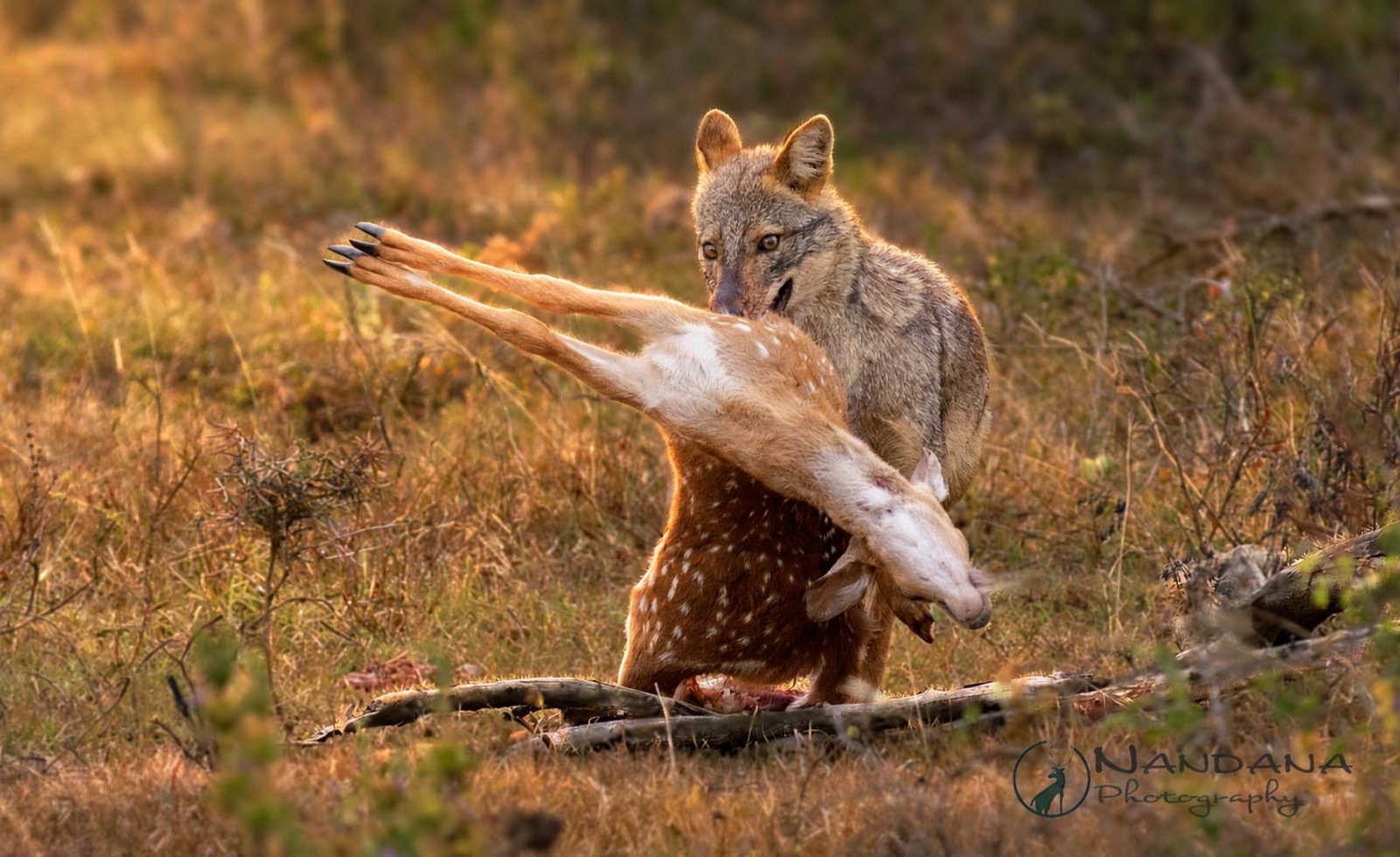
Sri Lankan Jackal: Life, Hunting and a Memorable Encounter in YalaThe golden jackal (Canis aureus) is the only jackal species found in Sri Lanka and the island’s only native wild member of the dog family. Sri Lankan jackals are commonly classified as the subspecies Canis aureus naria. With pointed ears, a narrow muzzle, a bushy tail and a golden-brown coat marked with darker fur along the back, this adaptable animal is a familiar resident of the island’s wilderness.
Jackals inhabit grasslands, scrublands, dry forests and agricultural surroundings. In places such as Yala National Park, they can sometimes be seen moving across open ground or exploring the edges of vegetation. They also visit areas near human settlements, particularly where discarded food is available. Although mainly active during the evening and at night, jackals may forage during daylight where disturbance is low.
For many Sri Lankans, the jackal is a character remembered from childhood stories—a clever animal that finds its way through difficult situations. Hares often appear in those same stories. In the wild, however, hares are among the animals jackals hunt. Their relationship is part of the natural connection between predators and prey.
The jackal’s diet extends well beyond hunting hares. As an omnivore, it eats small mammals, birds, insects, fruit and carrion. A Sri Lankan study based on a small sample identified rats, small birds, insects, jackfruit, banana peel and cooked rice among the food remains examined. This varied menu reflects the jackal’s ability to use whatever suitable food its surroundings provide.
Jackals can also obtain food from animals killed by other predators. Sometimes this means feeding on abandoned remains. In other cases, a jackal consumes part of a carcass that the original hunter could otherwise return to and eat. Researchers describe this taking of another predator’s food as kleptoparasitism. It does not always involve a confrontation: a jackal may take advantage of the hunter’s absence to feed. Such behaviour has been documented in golden jackals, although the circumstances vary between encounters.
A recent encounter at Digan Wala in Yala National Park gave us another reason to watch these animals closely. This time, the scene involved two jackals and the well-known male leopard, Nilame.
The two jackals approached Nilame and attempted to grab his tail. Nilame responded by chasing them away. But the encounter did not end there. The jackals returned, moved close again and repeated their attempts. Nilame chased them off once more, only for them to come back. After these repeated disturbances, he eventually moved away.
To those of us watching, it looked as though two mischievous jackals were teasing a powerful leopard. It was an amusing scene, but there was also much to learn from it. The jackals approached, retreated when chased and then returned. Whether their behaviour involved play, curiosity or an attempt to drive the leopard away cannot be established from this single observation. Understanding an encounter like this requires attention to its wider context, as well as the actions we can clearly see.Finding food and responding to other animals are only part of a jackal’s daily life. Shelter matters too. Dense scrub and woodland cover offer places to rest and remain concealed, and such cover becomes especially important during the period when pups are being raised. These less conspicuous patches of vegetation form a valuable part of jackal habitat.
Jackals also perform useful work within the ecosystem. By consuming carrion, they help remove animal remains and contribute to the movement of nutrients through the food web. Their role as scavengers connects them to the activities of larger predators and the natural process of decomposition.
Research on jackals’ ecosystem servicesTheir hunting brings them into a close relationship with Sri Lanka’s farming landscapes. Rats and other small animals can damage crops, and jackal predation may help regulate their populations. Researchers at the University of Colombo have highlighted the consumption of rodents in paddy fields and chena cultivations as an important contribution, while noting that the jackal’s economic value to agriculture has yet to be reliably established.
Where jackals live near villages, secure poultry enclosures and proper disposal of food waste can help reduce conflict. Visitors to wildlife areas can support their protection by keeping a respectful distance, avoiding feeding and allowing them to move freely.
Our encounter with Nilame and the two jackals at Digan Wala left us with a memorable wildlife story. It also encouraged us to look more closely at an animal we often recognise without stopping to observe. On your next visit to Yala, spend a few quiet moments watching a jackal. Its search for food, its movements through the habitat and its responses to other animals may reveal another fascinating chapter of Sri Lanka’s wild life.



Leave a reply